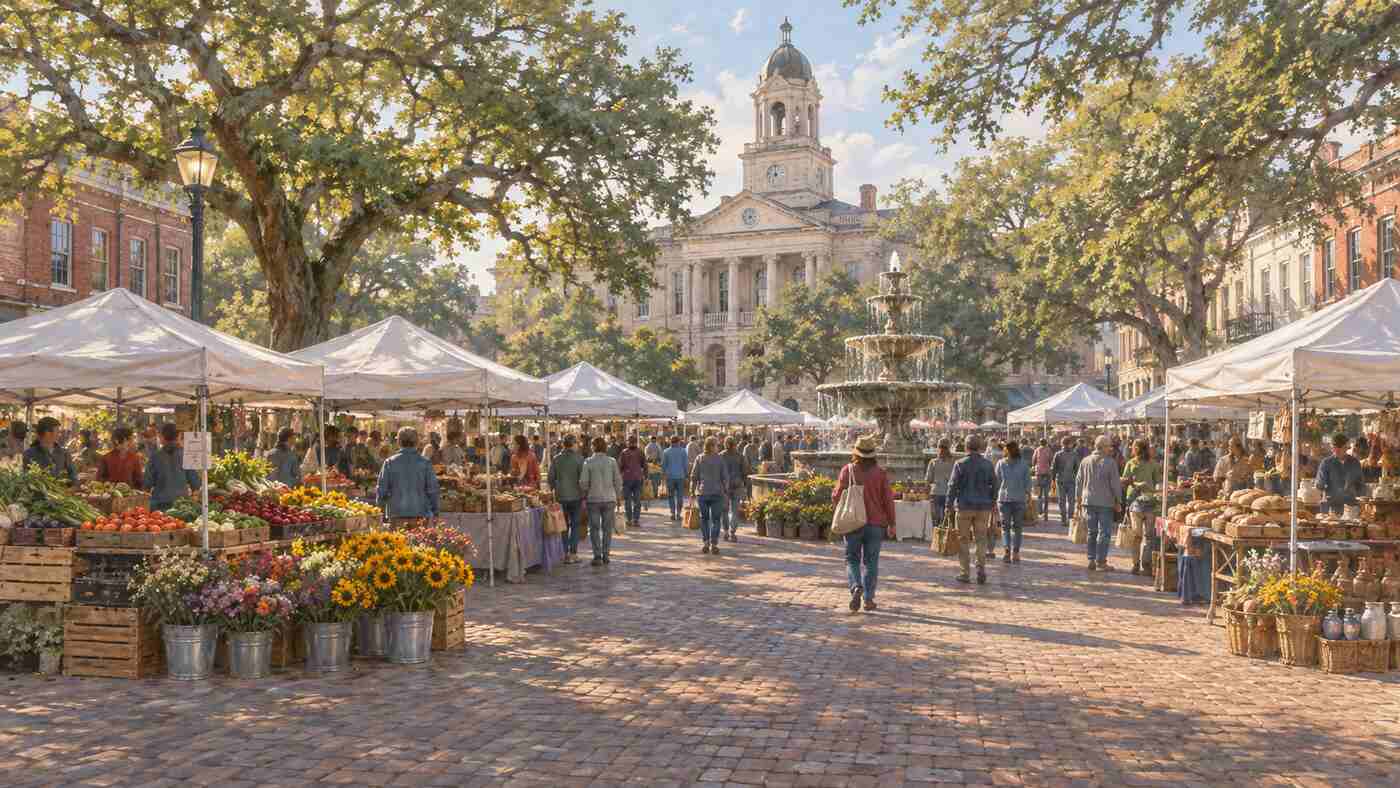
In short: The Fayetteville Farmers Market is a producer-only farmers market held on the downtown square in Fayetteville, Arkansas. It dates its founding to 1973 and is run by a cooperative owned by its vendors, who must grow or make what they sell in four northwest Arkansas counties. It meets on Saturdays, adds Tuesdays and Thursdays from May to September, and moves indoors in winter.
For more than half a century, Saturday mornings on the Fayetteville square have meant farm trucks, folding tables and crowds. The market is one of the oldest institutions of the local food scene in northwest Arkansas, and it was a neighbour and supplier for farm-to-table restaurants such as Greenhouse Grille. This guide covers its history, rules, schedule and awards, using the sources listed at the end. It is part of Greenhouse Table, an independent guide, and is not an official market publication; check the market’s own site for current hours.
What is the Fayetteville Farmers Market?
A farmers market is a regular public market where farmers and food makers sell directly to shoppers. A producer-only market is one where vendors may sell only what they grow or make themselves, rather than reselling wholesale goods. The Fayetteville Farmers Market says that all its producers grow and make their products in Washington, Madison, Benton and Carroll counties.
The market is operated by the board of the Rural Mountain Producers Exchange (RMPE), which the market describes as “a cooperative owned by the market vendors”. A cooperative is a business owned and run by its members, here the farmers and makers who sell at the market.
How the market began
The market’s own site says “Locally Grown Since 1973”, and Talk Business & Politics and the NWA Democrat-Gazette also give 1973. In a 2023 report by 5NEWS on the market’s 50th anniversary, founder Marcella Thompson recalled starting the market in 1974. We note the difference; the market itself uses 1973.
The early days were modest. Thompson told 5NEWS: “We had not much of anything to sell, but people came out of curiosity.” She said insurance agent Wilbur Watson, who became the first manager, helped gather farmers and paid her five-dollar membership fee, telling her, “If you’re gonna have a farmers market, you really need some farmers.” Market coordinator Teresa Maurer told Talk Business in 2014 that the market had grown “from just six vendors per market day to 70 on Saturdays”.
When is the Fayetteville Farmers Market open?
The market’s site lists Saturdays on the downtown square, with the market indoors from January to March, and Tuesdays and Thursdays on the square from May to September. The NWA Democrat-Gazette reported in 2018 that about 60 vendors set up from 7 a.m. on market days. Talk Business described the Saturday market from April to November as drawing thousands of visitors to the square. 5NEWS reported in 2023 that the market was open year round and also ran an online market.
Market at a glance
| Item | Detail |
|---|---|
| Founded | 1973 (market’s own date; founder recalls 1974) |
| Location | Downtown square, Fayetteville, Arkansas |
| Run by | Rural Mountain Producers Exchange, a vendor-owned cooperative |
| Producer area | Washington, Madison, Benton and Carroll counties |
| Days | Saturdays; Tuesdays and Thursdays May to September; indoors January to March |
| Award | America’s Favorite Farmers Market, large markets, 2012 |
What the market sells
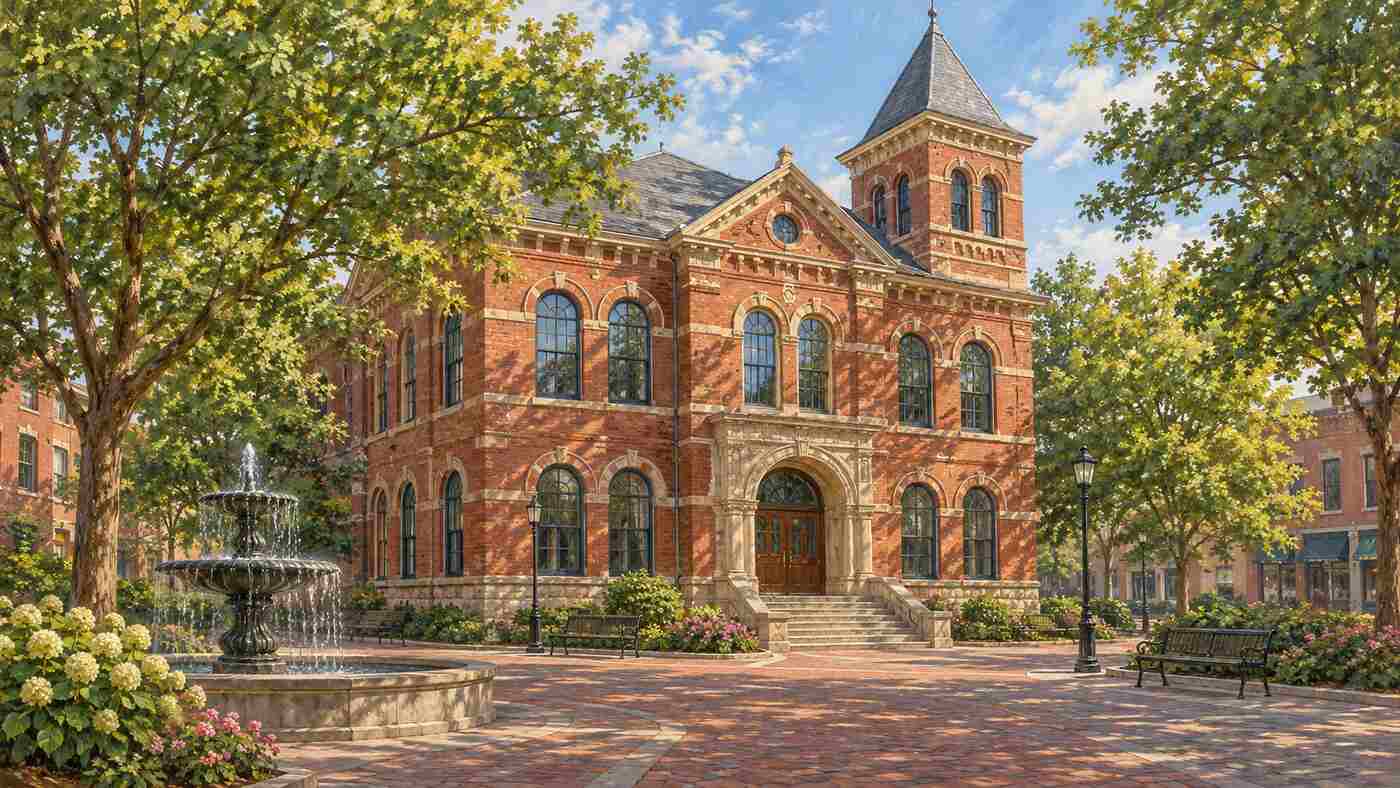
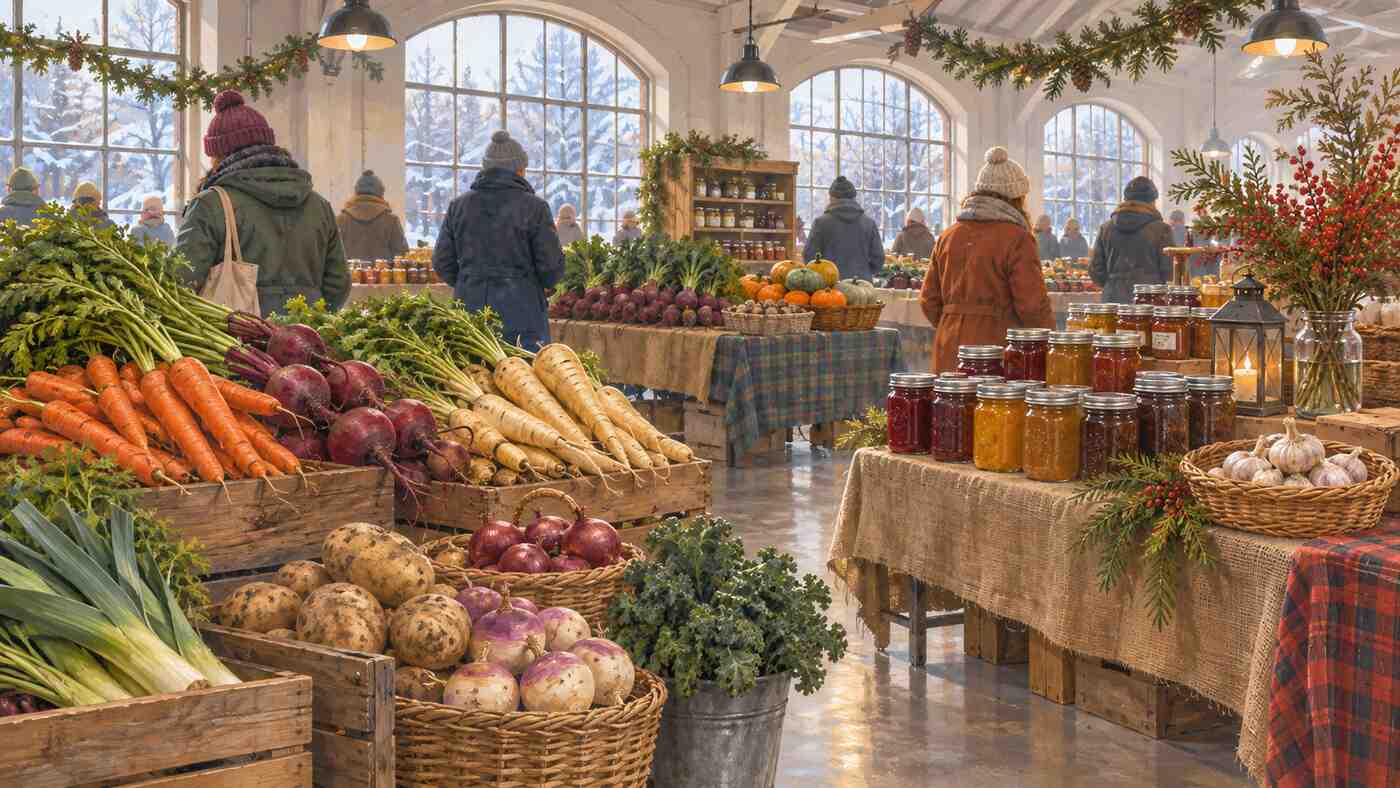
Talk Business listed the range in 2014: fruits, vegetables, flowers, crafts, fine art, eggs, honey, baked goods, plants, meats, jams and jellies. Because vendors must grow or make their goods within the four counties, what appears on the tables follows the local growing season. The Arkansas Department of Agriculture publishes a local harvest calendar showing when crops come into season in the state, a useful guide to what to expect month by month.
Farm-to-table restaurants grew up in the same scene. The archived website of Greenhouse Grille, in the Mill District, noted in 2010 that the restaurant had become neighbours with a Thursday evening farmers market; the page does not say which market that was. Our history of Greenhouse Grille follows that restaurant from 2006 to 2018.

The downtown square
The square is the centre of downtown Fayetteville. Talk Business called it “the heart and soul of downtown” in 2014, noting the Old Post Office building in the middle of the square and the First Thursday arts events held there from March to October. Maurer said several businesses had moved to the square in the previous two years to take advantage of the market’s draw.
Awards and 50 years
Farm Flavor reports that the market won the American Farmland Trust’s America’s Favorite Farmers Market title for large US markets in 2012. 5NEWS reported that the market marked its 50th anniversary on Saturday 17 June with food, a proclamation and a ceremony. Long-time vendor Mark Cain, who arrived from Mississippi with a load of watermelons and a card-table stand, was described as the longest-active member. 5NEWS also reported that markets in Springdale, Eureka Springs and Bentonville followed Fayetteville’s example, copying some of its bylaws.
The market’s growth fits a national pattern. The USDA’s Economic Research Service reports that US farmers markets rose from 1,755 in 1994 to 8,771 in 2019. For what the phrase farm to table means and where it came from, see our guide to what farm to table means; for how to tell whether a restaurant really buys from markets like this one, see how to check farm-to-table claims.
Key takeaways
- The Fayetteville Farmers Market dates its founding to 1973, though its founder recalls 1974.
- It is a producer-only market run by a vendor-owned cooperative.
- Vendors must grow or make their goods in Washington, Madison, Benton or Carroll counties.
- It meets on the downtown square on Saturdays, with extra days in summer and an indoor winter market.
- It won America’s Favorite Farmers Market for large markets in 2012.
Common questions
When did the Fayetteville Farmers Market start?
The market and several news reports give 1973. In a 2023 interview with 5NEWS, founder Marcella Thompson recalled starting it in 1974. The market celebrated its 50th anniversary in June 2023, which follows the 1973 date.
Can anyone sell at the Fayetteville Farmers Market?
No. It is a producer-only market. The market says all its producers grow and make their products in Washington, Madison, Benton and Carroll counties, and it is run by the Rural Mountain Producers Exchange, a cooperative owned by its vendors.
Is the Fayetteville Farmers Market open in winter?
Yes. The market’s site says it moves indoors from January to March, and 5NEWS described it in 2023 as open year round. Check the market’s own website for current locations and hours before you go.
Where is the Fayetteville Farmers Market held?
On the downtown square in Fayetteville, Arkansas, around the Old Post Office building. The winter market is held indoors, and summer adds Tuesday and Thursday markets on the square.
How we put this together: rules, counties and schedule come from the market’s own site; history and growth come from Talk Business & Politics, the NWA Democrat-Gazette and 5NEWS, which disagree on the founding year by one year; the award comes from Farm Flavor; national numbers come from the USDA Economic Research Service.
Sources
- Fayetteville Farmers Market: About us
- Talk Business & Politics: The Fayetteville square is still the heart and soul of downtown, 2014
- NWA Democrat-Gazette: A new day for the Old Post Office, 2018
- 5NEWS: Fayetteville Farmers Market celebrates 50th anniversary, 2023
- Farm Flavor: Arkansas farmers markets provide fresh local food
- Arkansas Department of Agriculture: Local harvest calendar
- USDA Economic Research Service: Farmers markets chart of note
- Internet Archive: Greenhouse Grille home page, January 2010